
Slnmap (sln-map) · v0.16.0 · MIT
Which React screens break if you change this C# handler? Claude Code doesn't know. Fix that.
Slnmap builds one local knowledge graph across your C# backend and React frontend — so your AI agent checks dependencies, impact, and architecture before it edits your code, on either side of the wire.
$ dotnet tool install -g SlnmapRequires the .NET SDK 9.0+ (Node 18+ too, for the React side). Then run analyze → analyze-ts → link and connect via MCP.
install + MCP setup guide included
100% local. Your code never leaves your machine. Don't take our word for it — the source is open.
eShopOnWeb (10 projects) — real run, v0.10.0
problem
AI coding agents are powerful — and structurally blind.
It breaks hidden dependencies.
Your agent renames a method and misses 3 call sites behind an interface — or two React screens that call the endpoint it just changed. You find out in the PR — or in production.
It violates your architecture.
Suggestions that put data access in your domain layer — because it can't see the boundaries you spent years defending.
It loses the plot on large solutions.
500 files don't fit in a context window. Structure does. Your agent needs a map, not a bigger window.
how-it-works
From blind edits to informed ones — across the whole stack.
$ slnmap analyze ./MySolution.sln # C# graph, via Roslyn
$ slnmap analyze-ts ./frontend # + React/TS call sites
$ slnmap link # join them: which screens call which handlers
$ slnmap serve # connect over MCP
Map both sides
analyze builds the C# graph with Roslyn — symbols, calls, implementations, endpoints — in under a minute. analyze-ts adds your React/TypeScript call sites (Node 18+), and link joins them: which frontend call site hits which backend handler. One graph, on disk, both stacks.
Connect
One line in your MCP config plugs Slnmap into Claude Code. No cloud account, no API keys, nothing to sign up for.
Ask
Your agent now answers “which React screens break if I change this C# handler?” — before touching anything.
$ slnmap watch ./MySolution.sln
[19:19:53] re-analyzed 1 file(s) in 0.93s — graph 1,336 nodes / 3,497 edges, saved in 0.17s
slnmap watch keeps the compiler workspace warm and re-analyzes on every save — about a second per change on eShopOnWeb (real output, unedited), instead of a full workspace reload per run. Run slnmap serve beside it and your agent's answers stay fresh while you type.
$ slnmap check
Orphan calls: 1 found, 0 in baseline, 1 new
NEW POST src/components/ReportsDialog.tsx:10 (/api/reports) — verb-mismatch; no POST registered; GET /api/reports exists
Result: FAIL — 1 new orphan call(s)
slnmap check turns the graph into a CI gate: it fails only on what is new compared with a committed baseline — a frontend call no endpoint answers, a project dependency cycle, a project analyzed without its packages — and annotates the changed file under GitHub Actions. Routes your frontend serves itself go in an ignore list. Real output, unedited (slnmap's demo app).
impact-analysis
cross-stack
The question this was built to answer.
After slnmap link joins your React call sites to their C# handlers, two things become possible that weren't before.
impact_analysis("BasketController.UpdateQuantities"):
[Endpoint] PUT /api/basket/{id}/items @depth 1
[FrontendCallSite] PUT src/services/basketService.ts:42:10 @depth 2
Change the handler, see the exact React call site that breaks — one graph, zero guessing. Real output, unedited (eShopOnWeb; also in the README).
1 orphaned call site(s) (verb-mismatch):
verb-mismatch (1):
POST src/components/ReportsDialog.tsx:10:23 (/api/reports) — no POST registered; GET /api/reports exists
The kind of bug that started this project: a frontend POST to a route the backend only serves as GET, caught and named by reason — never a guess. Real output, unedited (slnmap's demo app).
built in the open
Evaluated and fixed in public, not just built in public.
Three generations of pre-launch scrutiny, each one catching a different class of bug before it shipped. The full story is on dev.to; the receipts are in the changelog.
Gen 1 — independently evaluated.
A field evaluation against a large production codebase found one confident-lie defect class — fields reported "no usages" when real usages existed. Fixed and shipped within 48 hours.
Gen 2 — shaped by production feedback.
The MCP error-handling overhaul was designed from an r/mcp community thread — failures now come back machine-checkable, with a corrective message instead of a stack trace.
Gen 3 — three field trials, three bug generations.
Every cross-stack release shipped only after a trial against a codebase outside its own test corpus: v0.11.0 caught a silently-invisible HTTP verb (superagent's .del()), v0.12.1 caught the linker reporting false ambiguity between unrelated routes, and v0.12.2 caught a fluent method chain silently miscounting call sites plus a string-concatenated URL silently dropped instead of disclosed. All three fixed before anyone outside this project saw them.
Never guessed, always disclosed.
Anything not statically resolvable is counted and reported, never guessed. On eShopOnWeb, 26 HTTP endpoints are mapped and the 7 registrations that can't be resolved statically are listed with their locations; on the RealWorld sample app, 22 of 22 frontend call sites link to their endpoint.
visualize
See the shape of your solution.
slnmap viz exports the graph as a single interactive HTML file — no server, no CDN, works fully offline. It opens collapsed to one node per project; click to drill into a namespace or class and see its dependency edges.
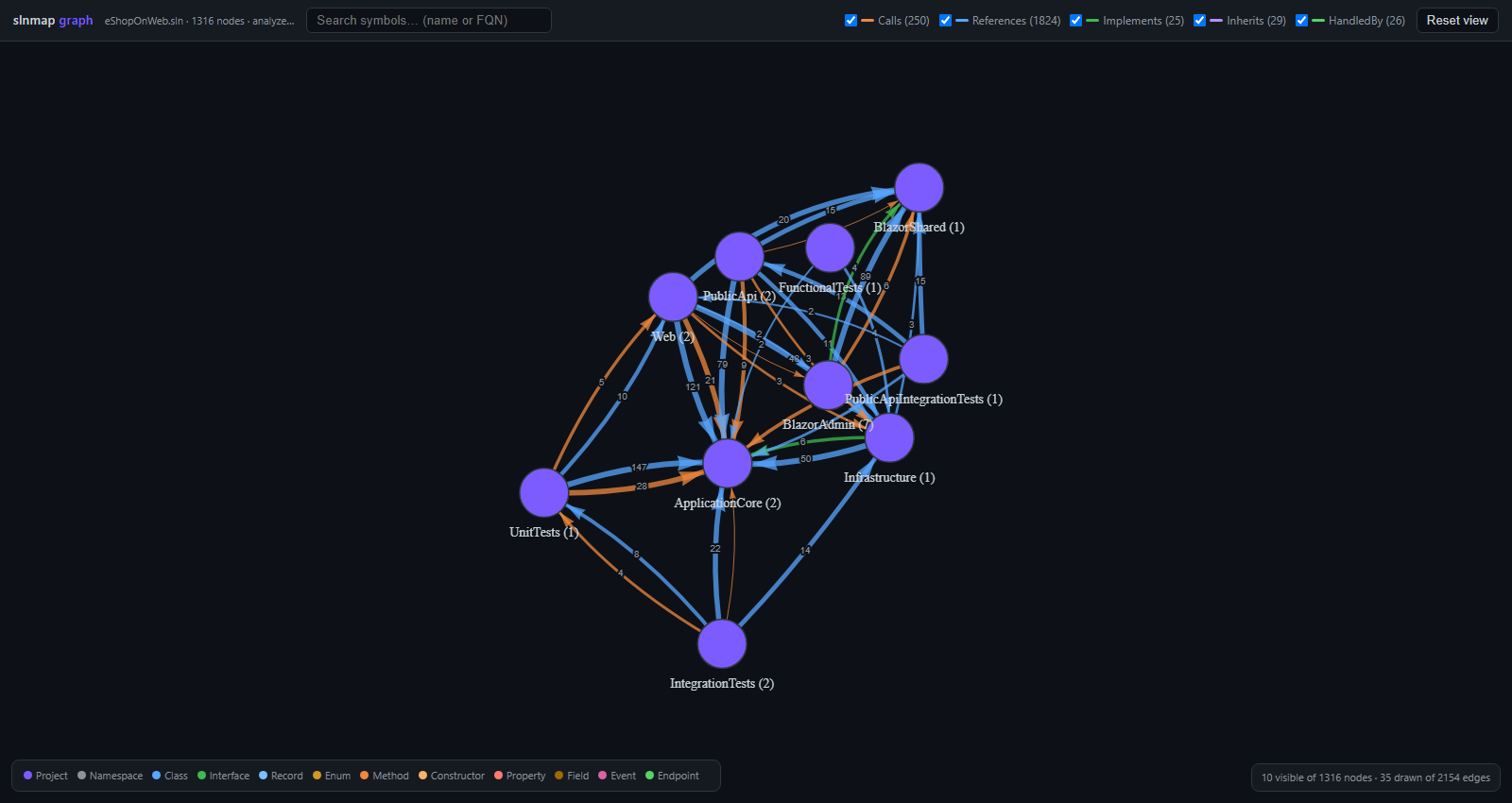
eShopOnWeb (10 projects) — real output, unedited.
faq
Questions you should be asking
Three levels of understanding code:
- text (grep/embeddings) finds what looks similar
- syntax (tree-sitter) sees structure but can't resolve which method a call actually hits
- semantics (Roslyn) resolves calls through interfaces, DI, and generics
Slnmap is the third level — the only one where "what breaks if I change this?" has a correct answer. And unlike your IDE's internal understanding, it's exposed as tools your AI agent can query before it edits.
Yes — the CLI and MCP server are MIT-licensed, and they'll stay that way. Future hosted or team-oriented features may be commercial. Star or contribute on GitHub.
Nineteen read-only MCP tools your agent can call — two of them cross-stack:
find_orphan_calls— frontend call sites with no matching endpoint, grouped by exact reason (no-match, verb-mismatch, verb-unknown).list_frontend_callsites— every React/TS HTTP call site with its live linking status.find_symbol— locate a type or member by name anywhere in the solution.get_dependencies— see what a given symbol depends on, paging through large results.impact_analysis— what breaks if you change a symbol: every caller and implementation, across projects — and, onceslnmap linkhas run, every React call site downstream of the C# handler it hits.list_endpoints— every HTTP endpoint your solution registers (Minimal APIs and attribute-routed controllers), grouped by project, filterable by verb or route prefix.find_endpoint— the endpoint that handles a route or a concrete request path, like/api/orders/42— plus which frontend call sites hit it.get_architecture_overview— the projects and how they depend on each other.find_usages— everywhere a symbol is used, optionally including its implementations.find_implementations— who implements an interface or overrides a member.get_type_hierarchy— the base and derived type tree.find_tests_for_symbol— which tests exercise a symbol.get_project_dependencies— the project reference map, with the most-coupled hotspot.find_circular_dependencies— dependency cycles between projects or namespaces.get_symbol_source— the actual source of a symbol, straight from the graph's stored location.get_di_registrations— what the DI container is wired with: service, implementation and lifetime.get_attribute_usages— where an attribute like[Authorize]is applied.find_callers_of_external— where your code calls a package or the framework, like EF Core.find_unused_symbols— public and internal code nothing references, with the caveats stated up front.
Run slnmap watch (new in v0.10) — it analyzes once, keeps the compiler workspace warm, and re-analyzes on every file save. On eShopOnWeb (10 projects), a one-file change lands in the graph in about a second: re-analyzed in 0.93s, saved in 0.17s — versus paying a full workspace reload for each run-and-exit slnmap analyze. Run slnmap serve beside it and your agent's answers stay fresh while you type. Structural changes (csproj/sln) trigger an announced full reload — membership is never guessed. Prefer one-shot? slnmap analyze still re-walks only changed files without dropping edges owned by files it didn't touch, and upgrading the tool triggers a one-time full rebuild automatically. Either way your queries stay instant — the graph is already on disk.
No — every tool response is token-budgeted by design. Summaries first, drill-down on demand. The point is to give your agent structure instead of flooding it with source.
No. Analysis runs locally and the graph lives on your machine. No cloud, no telemetry on your code. Ever.
The tool itself runs on the .NET SDK 9.0+, and analyzes C# solutions targeting .NET 8 and 9 (earlier targets are untested — feedback welcome). analyze-ts additionally requires Node 18+ and analyzes React/TypeScript frontends. More languages and frameworks based on user feedback.
HTTP endpoints are extracted from ASP.NET Core Minimal APIs (including MapGroup prefixes and the CleanArchitecture-template MapGroup(this) convention) and attribute-routed controllers (including [controller]/[action] tokens and inherited [Route] from base controllers).
This audience trusts disclosed limits more than feature lists, so here they are:
- Blazor & Razor Pages — conventional routing and Razor Pages are detected and disclosed, not modeled; .razor markup is counted (file totals only) but not analyzed (#30).
- MediatR-style dispatch — runtime request/handler dispatch isn't traced;
impact_analysis/find_usagesstop at the request record, correctly not claiming a link they can't see — walk through the record to reach the handler. - Angular & Vue HTTP clients — call sites on clients besides axios and
fetch(Angular'sHttpClientincluded) are honestly disclosed as unresolved, never silently dropped or guessed at. - Monorepos — single, flat
tsconfig.jsonfrontends are field-verified; project-references/monorepo tsconfigs aren't yet — pointanalyze-tsat each package individually in the meantime.
Any MCP client can connect — it's a standard MCP server over stdio. Claude Code is first-class and what it's tested with; Cursor and other MCP clients use the same server.
Right now — it's v0.16.0, free and open source (MIT). Install from NuGet today and connect it to Claude Code in a few minutes. No signup, no waitlist.
Give your agent a map — of both stacks.
v0.16.0 — free and open source (MIT). Install it and connect it to Claude Code in a few minutes.
$ dotnet tool install -g SlnmapRequires the .NET SDK 9.0+ (Node 18+ too, for the React side). Then run analyze → analyze-ts → link and connect via MCP.